The Security Layer for the Quantum Era
QLAD starts with confidential computing, makes it accessible, and expands into the security layer for quantum-resistant cyber infrastructure.
TL;DR
Quantum hardware is progressing faster than most institutions are prepared for. Gate fidelity, logical qubit counts, and error-correction milestones are the metrics now, not research headlines.
For certain problems, quantum machines can compress work that would take classical systems years, and in some cases millions of years, into hours. That is why governments, hyperscalers, finance, pharma, AI labs, and defense agencies are organizing around it now.
The security consequence is direct: the same machines can eventually break the public-key cryptography that protects the internet, cloud, financial system, government stack, and defense infrastructure. Post-quantum cryptography is necessary, but it is not enough. Sensitive data still has to be computed on.
That creates the need for a central control plane and security layer: prove the workload, enforce policy, release keys, run isolated, and leave evidence behind.
QLAD is that layer: a first-of-its-kind quantum cyber security company that starts with confidential computing, makes it accessible, and expands across the full data lifecycle.
1. Quantum Is Becoming a Major Computing Market
The question is how quickly the industry can add nines: 99.9%, 99.99%, 99.999%. Each additional nine is an order-of-magnitude improvement in reliability, and reliability is what turns fragile qubits into useful machines.
Governments, hyperscalers, defense agencies, pharma, finance, and AI labs are all moving. The upside is not incremental. Quantum changes what can be simulated, optimized, searched, and attacked.
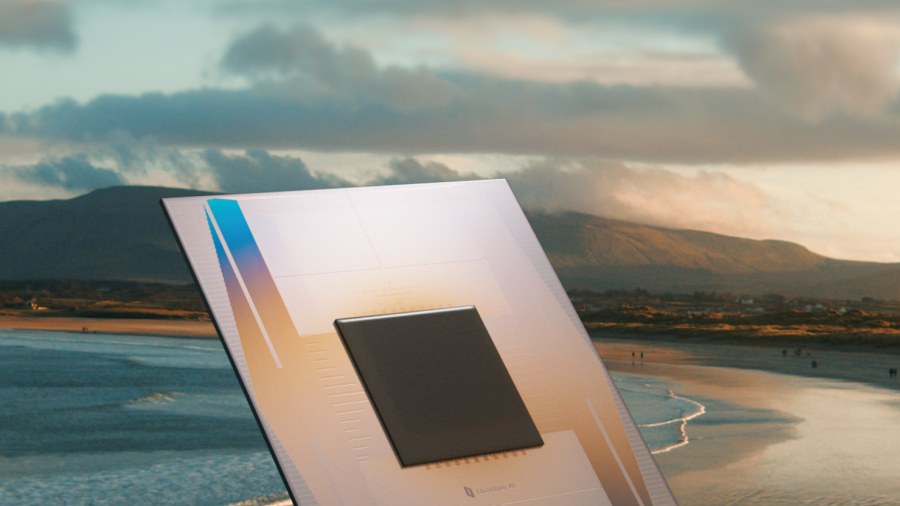
The progress is measurable. Google's Willow demonstrated a distance-7 surface code with 0.143% error per cycle. Quantinuum's Helios reported 99.921% two-qubit gate fidelity and 48 logical qubits under active error correction.[1] The metrics are logical qubit counts, gate fidelity, coherence time, and error-correction overhead. Each decimal point of improvement is an order-of-magnitude gain in reliability, and reliability is what turns fragile qubits into useful machines.
Recent Nobel Prizes have gone to quantum information science and quantum dots.[2, 3] Governments are funding quantum as strategic infrastructure. The security architecture has to move before the capability arrives, not after.
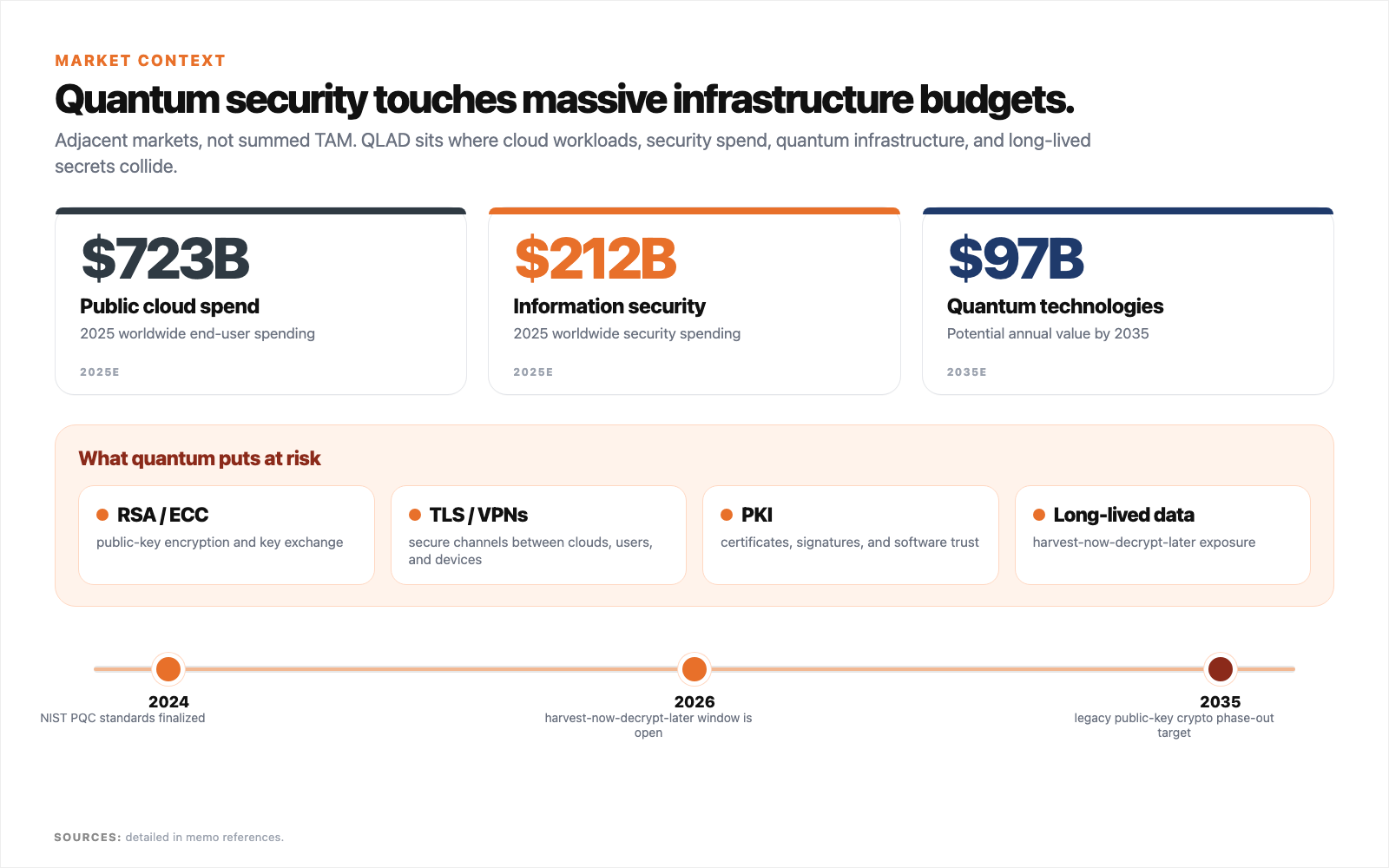
One market estimate puts quantum technologies at up to $97 billion by 2035.[4] The machines are not yet cryptographically relevant. The engineering curve says they will be.
The security implication is the urgent part.
Much of today's digital trust depends on public-key cryptography: RSA, elliptic curve cryptography, key exchange, digital signatures, certificates, and the systems built on top of them. A cryptographically relevant quantum computer would compromise that foundation. Not every cryptographic primitive fails the same way, but the practical consequence is clear enough: the internet, cloud, government, finance, defense, and critical infrastructure all have to migrate.
That migration cannot wait until the day the machine arrives.
2. The Breach Can Happen Before the Breakthrough
Quantum risk is strange because the attacker does not need the quantum computer today. They only need patience.
An adversary can steal encrypted records, traffic, intelligence, health data, financial data, source code, model artifacts, or operational data now and hold it. If the secret remains valuable for ten or twenty years, then today's encryption may not protect tomorrow's exposure. This is the harvest-now-decrypt-later problem.
The resource estimates are moving in the wrong direction for defenders. Craig Gidney's 2025 analysis reduced the estimated physical-qubit requirement for breaking RSA-2048 from roughly 20 million noisy qubits to under 1 million, assuming ~10-3 physical gate errors and ~1 μs surface-code cycles.[5] Google Quantum AI has also estimated that 256-bit elliptic-curve signatures could be broken with fewer than 1,200 logical qubits, or fewer than 500,000 physical qubits under similar hardware assumptions.[6] These are estimates, not predictions that the machine exists tomorrow. But the direction matters: software and circuit improvements can pull the cryptographic target closer even before the hardware fully arrives.
That turns quantum security from a research topic into a planning problem. The buyer is not only the CISO. It is the government agency, defense contractor, hospital system, bank, energy operator, public infrastructure network, and AI company whose data remains valuable long after it is collected.
NIST has already finalized the first post-quantum encryption standards, including ML-KEM for key establishment and ML-DSA / SLH-DSA for digital signatures.[7] The NSA has already published CNSA 2.0 transition guidance for national-security systems.[8] Those moves matter because institutions do not migrate cryptography quickly. Large systems have old protocols, embedded devices, vendors, third-party integrations, compliance obligations, and operational constraints. The deadline begins years before the failure becomes visible.
That is why we are already talking to major agencies and large institutions about the same basic problem: how to keep sensitive data encrypted and protected no matter where it is, where it moves, or what has to compute on it. The answer cannot only be a new algorithm. The answer has to become an operating control.
That is the opening for QLAD: a control plane that proves what is about to run before secrets are released and sensitive computation begins.
3. Confidential Computing Is the Missing Layer
Most of the quantum-security conversation starts with algorithms. That is correct, but incomplete. Post-quantum cryptography changes the math protecting keys, signatures, and channels. It does not by itself answer the runtime question of which workload should be trusted with sensitive data once computation begins.
Algorithms protect data at rest and in transit. They help answer whether a message, file, connection, or signature can remain secure in a post-quantum world. But sensitive data eventually has to be used. It has to be processed, transformed, inferred on, routed, analyzed, audited, or acted upon by software. As the quantum transition forces institutions to inventory cryptographic dependencies, it also exposes a broader control problem: where is the proof that the environment touching the data is the environment policy intended?
Encryption protects data at rest. Confidential computing answers the next question: should this workload be allowed to touch the data at all?
That is where confidential computing matters. Confidential computing uses hardware-backed isolation and attestation to prove facts about the environment where code runs. The system can verify that a workload is running in an approved enclave, on approved hardware, with the expected measurement, under the expected policy, before keys or secrets are released.
The reason adoption has been slow is simple: confidential computing has been too hard to use. It has lived too close to chips, enclaves, cloud-specific implementations, and security research. QLAD starts there and makes the primitive accessible: containerized, policy-driven, and deployable in the way modern software already runs.
That is the land-and-expand wedge. Start with the hardest unsolved surface, data in use. Once QLAD controls the proof layer around the workload, it can expand across the rest of the data lifecycle: encrypt, move, compute, and store.
4. QLAD Is the Security Layer for the Quantum Era
QLAD packages that trust layer into a deployable system: prove the workload, enforce policy, release keys, run isolated, and leave evidence behind. Start here, then expand across the rest of the quantum-era security stack.
The broader ambition is larger. In the quantum era, companies need security across the same lifecycle: encrypt, move, compute, and store. QLAD is the security layer for that transition: policy, attestation, key release, isolation, evidence, and eventually post-quantum controls across the stack. The technical reason this category can become large is that quantum migration is not a single library upgrade. It is a multi-year control-plane migration across keys, certificates, protocols, workloads, vendors, hardware roots of trust, audit trails, and long-lived sensitive data.
Palo Alto and Fortinet became valuable because the network perimeter needed a control layer. CrowdStrike became valuable because the endpoint needed one. Okta became valuable because identity needed one. Wiz became valuable because cloud posture needed one; Google completed its acquisition of Wiz for $32 billion because cloud security became a strategic control point.[9]
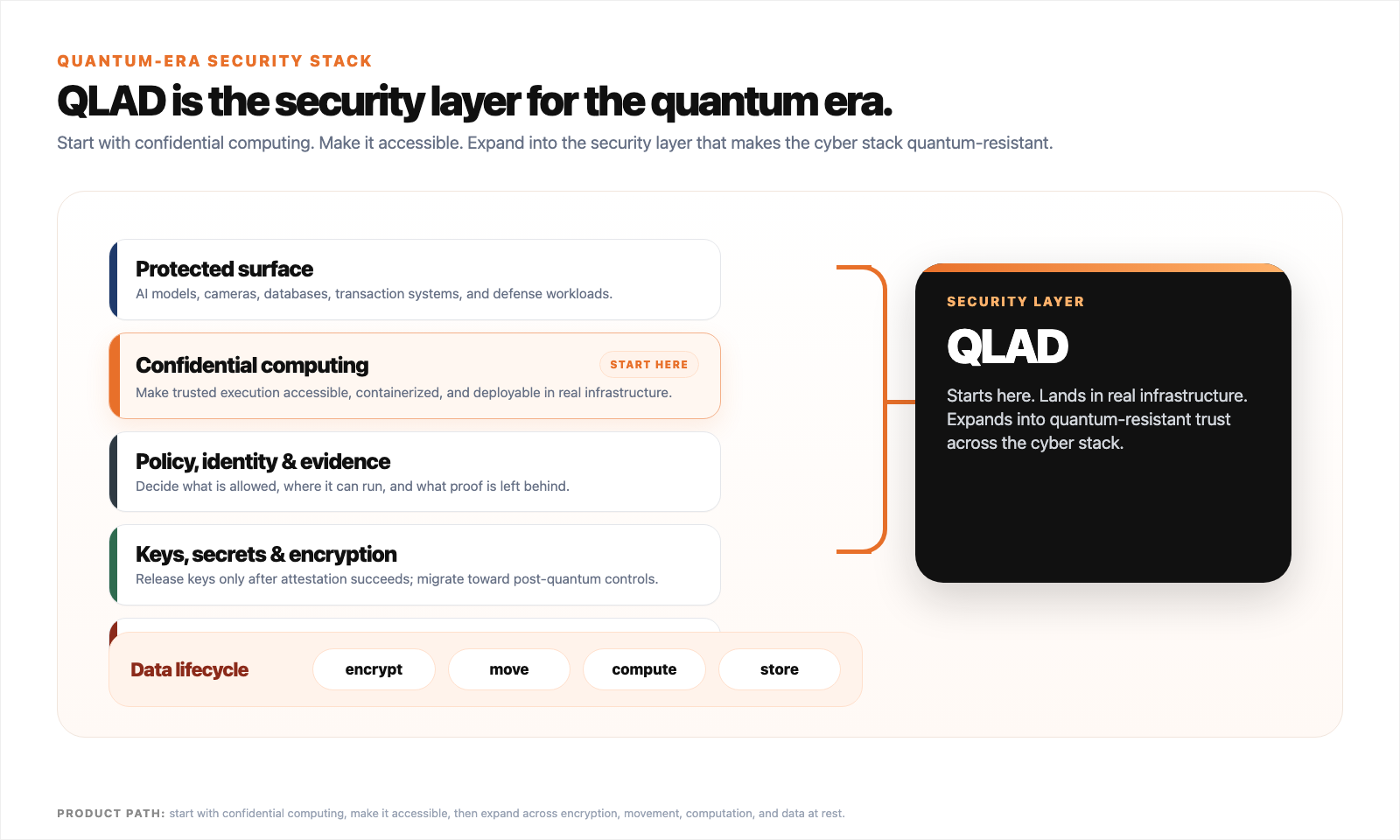
QLAD is pointed at the next layer: the quantum-era security layer around the workload and the data lifecycle. The first major quantum encryption break will not create the need. It will reveal the need all at once. The best time to sell insurance is after the fire. The best time to build the insurance company is before it.
Identity proves who you are. QLAD proves what is allowed to touch the data.
The first commercial wedge is regulated edge infrastructure. QLAD is Matrice's exclusive confidential-compute partner, with a signed commercial model of $1 per camera per month. Matrice's total addressable camera market is roughly 1.3 billion cameras, and its current platform already controls hundreds of thousands of deployed cameras. The known camera scope for QLAD is 651,500 cameras, representing $7.82 million of potential ARR at full activation. Those are activation scenarios, not current revenue.
The strategic point is not only cameras. Cameras prove the pattern: sensitive infrastructure at the edge, producing real-world data, running AI workloads, and needing verifiable execution before sensitive data is processed. The same need appears in AI systems, banks, defense networks, government workloads, healthcare, and critical infrastructure. Matrice proves the wedge. The next step is scaling that control layer across the rest of the world's sensitive compute.
5. Why I Am Building This
I have spent my career around computing infrastructure at moments when the old architecture stopped fitting the world.
At Rackable, we built the physical layer the internet and cloud era ran on: servers, racks, cooling models, power profiles, density, serviceability, and the operating assumptions of large-scale internet companies. The shift was not abstract. You could see it in the data centers. There is a patent trail behind that work, not just a biography: racks, storage density, and the mechanics of operating compute at scale. Customers no longer wanted proprietary black boxes. They wanted infrastructure that matched the way they actually operated.
At Facebook and Open Compute, the same pattern became a standard. Infrastructure that used to be hidden inside proprietary data centers became shared, inspectable, and optimized around how hyperscale operators actually built. Open Rack was not just a rack design. It was proof that when the architecture changes, the control point changes with it.[10]
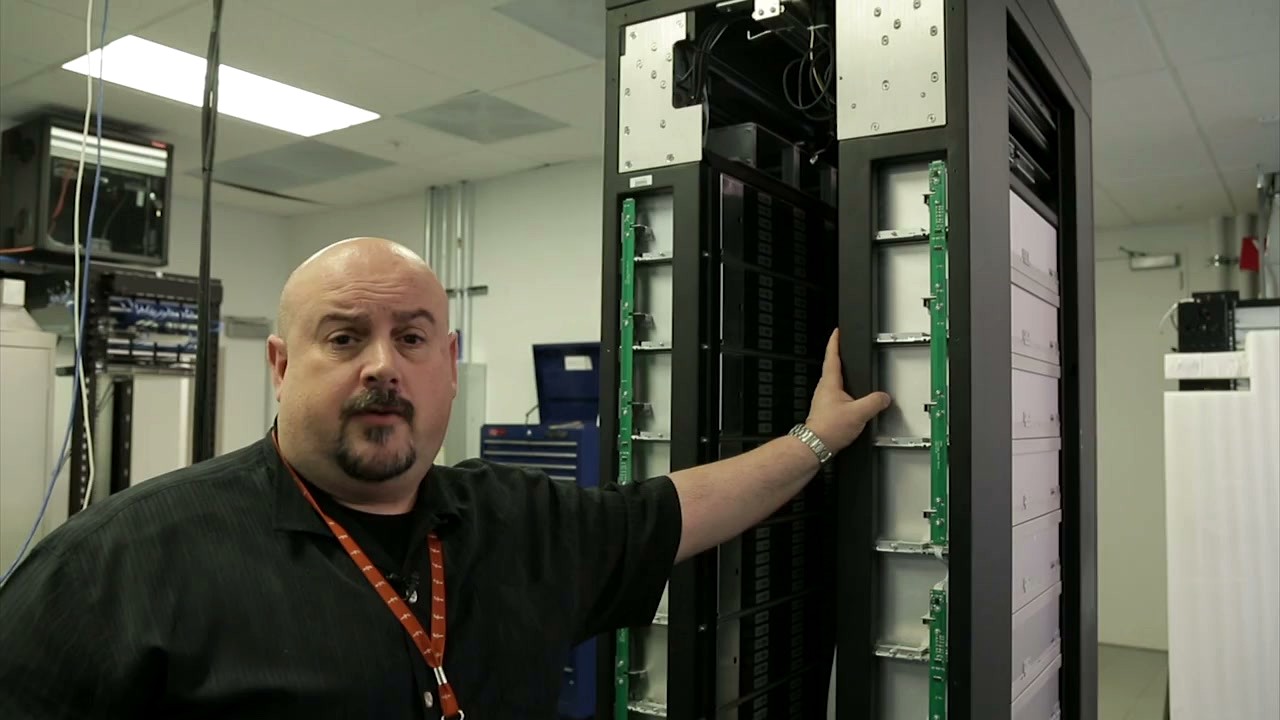
That pattern showed up again in cloud, open hardware, storage, and distributed infrastructure. A market begins to move when a design requirement becomes unavoidable. Resilience became unavoidable after companies realized one data center was not enough. Programmability became unavoidable when infrastructure had to be reproduced, automated, rented, metered, and operated as a service.
I believe quantum is the next frontier. The breakthrough will create enormous value, but it also forces a new security architecture. Trust is becoming the next unavoidable design requirement.
Sensitive computation can no longer depend on the assumption that the host is good, the administrator is good, the cloud boundary is good, and the encryption will remain good long enough. The market needs proof before compute. That is the gap QLAD fills.
6. The Team
QLAD brings together operators who have seen secure infrastructure from multiple sides: Navy SEAL command leadership, Five Eyes offensive cyber experience, Sylabs and Singularity container-security lineage, and the infrastructure operating pattern from Rackable, Facebook Open Compute, Sony, and RStor.
We have taken companies public, sold multiple companies, and executed at the highest level across multiple fronts. We are prepared to do it again.
7. The Round
We are raising a small strategic round. We expect it to fill quickly.
Quantum creates the urgency. Confidential computing creates the bridge. QLAD is building the security layer for the quantum era.
If that is how you see the world, I would like to talk.
Select References
[1] Google Quantum AI, Willow below-threshold surface-code error-correction results, including distance-7 code at 0.143% error per cycle; Quantinuum Helios technical disclosures reporting 99.921% two-qubit gate fidelity and 48 logical qubits under active error correction.
[2] Nobel Prize in Physics 2022, awarded for experiments with entangled photons and pioneering quantum information science.
[3] Nobel Prize in Chemistry 2023, awarded for the discovery and synthesis of quantum dots.
[4] McKinsey, "Quantum Technology Monitor 2025," estimate that quantum technologies could create up to $97 billion in annual value by 2035.
[5] Craig Gidney / Google Quantum AI, 2025 RSA-2048 resource-estimate work reducing the estimated requirement from roughly 20 million noisy physical qubits to under 1 million under stated hardware assumptions.
[6] Ryan Babbush and Hartmut Neven / Google Quantum AI, 2026 elliptic-curve cryptography resource-estimate work, including the estimate that ECDSA-256 could be attacked with fewer than 1,200 logical qubits under stated assumptions.
[7] NIST, "NIST Releases First 3 Finalized Post-Quantum Encryption Standards," August 2024.
[8] NSA, CNSA 2.0 guidance for national-security systems.
[9] Google announcement / public reporting on the completed $32 billion acquisition of Wiz, a cloud and AI security platform.
[10] Wired profile of Giovanni Coglitore; public Open Rack / Open Compute coverage naming Coglitore as a Facebook/Open Compute engineer and Open Rack participant.